
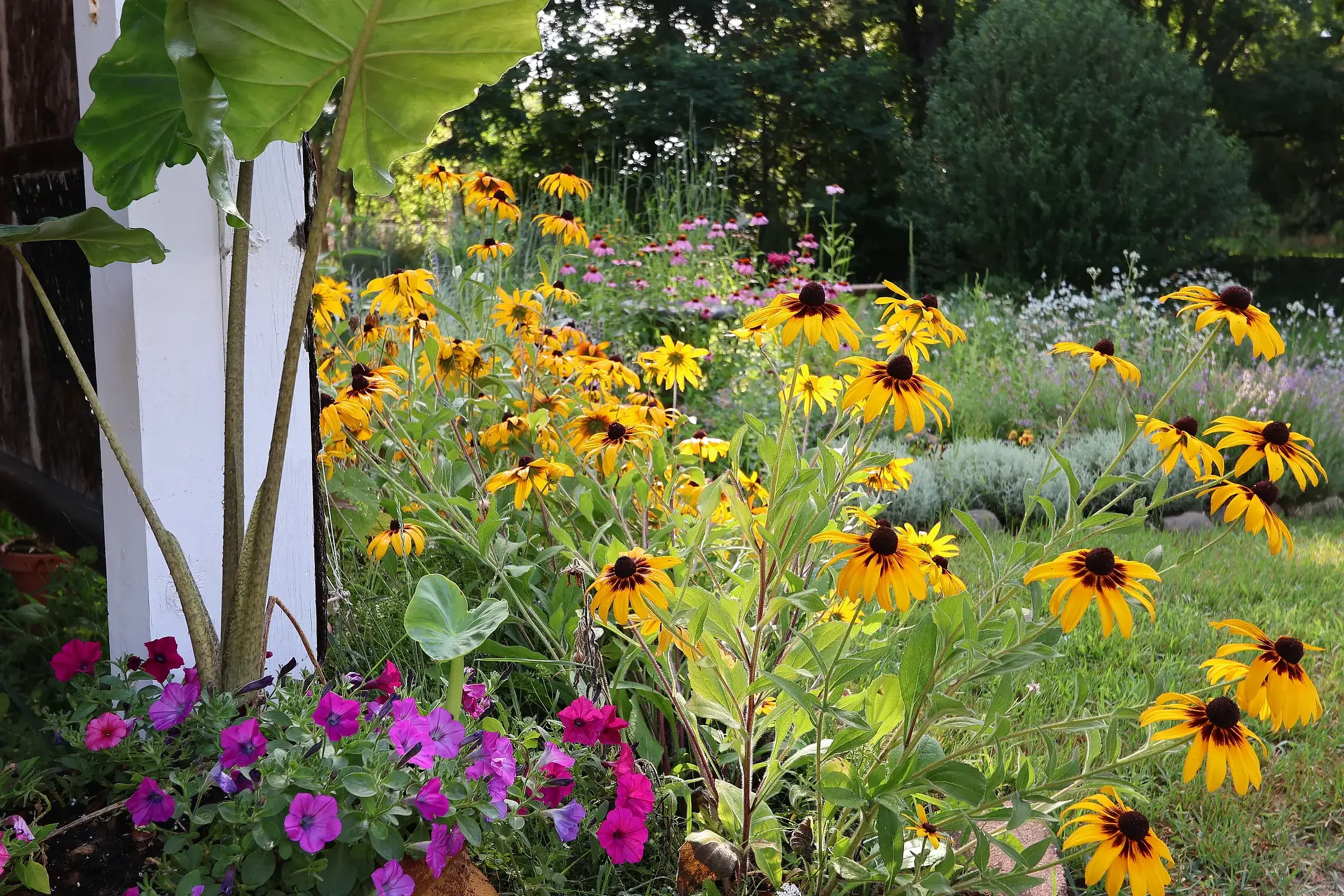
Commercial landscaping
Municipal & Public Spaces
Downtown planters, park beds, medians and rain gardens for townships, villages, downtown authorities and parks.
Why it pays
Greener public spaces raise values and handle stormwater.
Homes beside parks sell for more, rain gardens hold water that would otherwise run to the storm drain, and greening neglected land has been linked to less crime. For a township, village or downtown authority, planted public spaces are a visible return on public money, and native plantings cost less to keep than mown turf.
The research
What the studies found
-
8–10%
higher value for properties next to a passive park, the starting point recommended by a review of 33 U.S. studies.
-
96–100%
of rain and snowmelt events held and soaked in by rain gardens over four years in Madison, Wisconsin.
-
15–80%
lower capital costs when projects used low-impact stormwater design such as rain gardens instead of pipes and vaults.
-
29%
less gun violence around vacant lots that were cleaned and greened, in below-poverty Philadelphia neighborhoods.
Where the value comes from
How better planting pays back
-
01
Downtowns people want to visit
Planters and seasonal displays along main streets give visitors a reason to linger.
-
02
Stormwater handled where it falls
Rain gardens and bioswales soak up runoff from roofs, streets and lots.
-
03
Lower mowing bills
Native plantings on medians, ponds and park edges replace turf that has to be mown all season.
-
04
Habitat that's on view
Pollinator plantings in public places show residents what native gardens can be.
ROI calculator
What could planting return for you?
Put in your own figures. The estimate uses conservative ranges drawn from the research above, and grows as the plantings fill in.
Estimated net return after 20 years
—
- Return on investment
- —
- Pays for itself
- —
- Total invested
- —
Net value, mid estimate Low to high
What this assumes
A one-time gain of 0.25% to 1% of the value of property beside it. Parks add 8–10% to adjacent values (Crompton & Nicholls) and greening vacant lots about 5.6% (Heckert & Mennis, 2012), but planting a frontage or median is a much smaller change, so we take a small fraction. Crime and stormwater benefits are left out of the money.
Plantings take time to fill in, so the benefit grows: 35% in year 1, 70% in year 2, and 100% in year 3+.
Lawn turned to planting saves $0.03–$0.1 a square foot each year in mowing, watering and fertilizer, once the planting has settled in: 25% in year 1, 50% in year 2, and 100% in year 3+.
An estimate, not a promise. The ranges come from published research on trees, landscaping and green space, scaled down for one property's plantings; your results depend on your site, your customers and how the planting is cared for. Every study is linked on this page.
What we'd plant
Ideas for municipal & public spaces
- Downtown planters and hanging-basket programs
- Rain gardens and bioswales
- Native plantings on medians, pond edges and park borders
- Entrance and welcome-sign plantings
- Pollinator demonstration gardens
Sarah and her team have helped us both with a landscape design and installation project at a commercial rental property and with residential projects at our house. They are great with response times, organization and they just love all things plants. Really rewarding to work with.
Questions
Common questions from municipal & public spaces
Do you work with townships and downtown authorities?
Yes. We can provide a written plan and pricing for a board or council to review, and phase the work to fit a budget year.
Can a rain garden handle runoff from a parking lot?
Often, yes, when it's sized for the area that drains to it and planted with deep-rooted natives. In a USGS study, rain gardens held 96–100% of events over four years.
Do you build patios, walls or walkways?
No. Everything we do is plants: design, soil, planting, mulch and care. If your project needs hardscape, we can plan the planting around it and work alongside your contractor.
Other industries
Planting that pays, wherever you do business
-
Retail & Restaurants
Plantings that make people slow down, come in and come back: entrances, patios and storefront containers for shops, cafés and restaurants.
See the numbers -
Offices & Corporate Campuses
Grounds that help you lease space, welcome clients and give staff somewhere better to look, at lower upkeep than lawn.
See the numbers -
Apartments, HOAs & Rental Property
Curb appeal that helps units lease and residents stay: entrances, common areas and frontage for apartments, HOAs and rentals.
See the numbers -
Hotels, Inns & Event Venues
Grounds guests remember and photograph: entrances, patios, lakeside planters and gardens for hotels, inns, B&Bs and venues.
See the numbers -
Healthcare, Senior Living & Wellness
Calm, green places for patients, residents, families and staff: views, courtyards and healing gardens for clinics, senior living and wellness practices.
See the numbers -
Schools, Churches & Nonprofits
Gardens that serve a mission: outdoor classrooms, pollinator plantings, welcoming entrances and lower grounds costs for schools, churches and nonprofits.
See the numbers
Plan your project
Tell me about your property
A few quick questions, and I'll come back within 1–2 business days with ideas, next steps and a rough budget.